High-Level Launch Event Agenda
Click to view full event agenda
About Slovenia
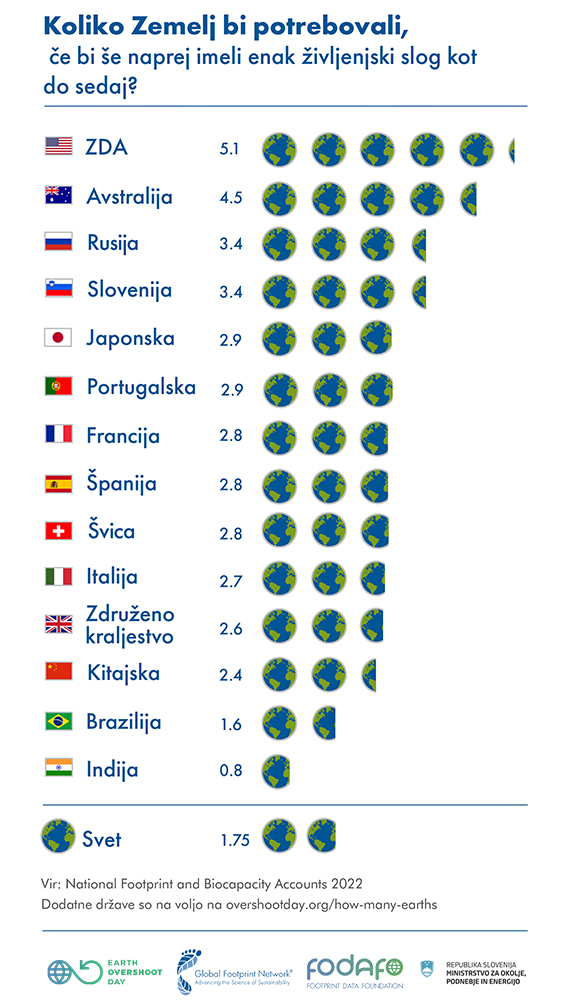
Slovenia has always been known for its breathtaking landscapes, rich biodiversity and commitment to sustainable development. More than half of its territory is covered by forests, it is one of the most water abundant countries in Europe and its Natura 2000 sites cover more than 37% of the country’s territory. But Slovenia also faces unprecedented challenges – it’s Ecological Footprint has increased after the global pandemic, requiring urgent attention and collective action.
The Slovenian Development Strategy 2030, adopted by the Government of the Republic of Slovenia in December 2017, includes the Ecological Footprint among the performance indicators and plans to reduce it by 20% by 2030 (from 4.7 gha/person in 2013 to 3.8 gha/person in 2030). Slovenia is the first EU country to include the Ecological Footprint in its National Development Strategy. The objective of reducing the Ecological Footprint is also included in the National Environment Protection Programme until 2030.
The carbon Footprint is the largest part of Slovenia’s Footprint (around 60%), mainly due to large emissions of carbon dioxide and other greenhouse gasses. For this reason, the objective of reducing the Ecological Footprint is directly linked to climate change mitigation.
Slovenia believes that a combination of different measures in the framework of the European Green Deal with ambitious national climate and energy policies (NEPN) and accelerated transition to a circular economy (Climate KIC – Deep Demonstration project to decarbonize Slovenia) will contribute to reaching the goal of 3.8 gha/person.
“The largest contributors are emissions from transport, especially private transport, and energy consumption in households, the carbon Footprint of services is also high. Recognizing this, we recently established for the very first time a ministry for climate, giving climate action the attention it needs. At the same time, we have transferred energy and transport planning to the Ministry’s remit – two sectors with the biggest decarbonization challenges and which can make a major contribution to reducing the country’s Ecological Footprint” explains Minister for the Environment, Climate and Energy Bojan Kumer.
Slovenia’s Ecological Footprint is monitored on an annual basis and presented in national development reports prepared by Slovenia’s Institute for Macroeconomic Analysis and Development and in the national State of the Environment Report which is to be published at least every four years.
In addition, Slovenia included the Ecological Footprint as a recommended indicator in the methodology for regional development planning. Six of twelve Slovenian regions have now included the Ecological Footprint in their regional planning.
Case Studies
Slovenia’s first almost zero-energy kindergarten made of Slovenian wood
The municipality of Selnica ob Dravi and the companies GIC GRADNJE and Lumar IG have signed a contract for the construction of a sustainable kindergarten made of wood. It will be the first almost zero-energy wooden kindergarten, which will require extremely low energy costs. It is also the very first public facility in Slovenia to be built entirely from Slovenian wood. The patented iQwood solid wood construction, free of glues, metals and chemicals, was chosen to make the kindergarten even better and more pleasant for the children.The new kindergarten will be spread over an area of just over 3000 square meters. Once built, it will have 10 sections and will include a central space and a sports playroom, terraces, a distribution kitchen, assistants’ rooms, administrative and utility areas. The kindergarten will be accompanied by playgrounds and a car park.
By producing polymers and fibres sustainably, they enable a circular economy
Aquafil is an international company specialized in the production of polyamide fibres used in a variety of products including clothing, carpets and industrial materials. It is committed to sustainable development and innovation in the field of environmental responsibility. They focus their operations on reducing their environmental impact. They have developed an innovative technology, ECONYL®, which enables the recycling of waste (fishing nets) and other waste materials and converts them into high-quality polyamide fibres for the textile industry. This helps to reduce waste and use of existing resources. By using ECONYL® technology, Aquafil actively promotes the concept of a circular economy. Instead of materials becoming waste, they are recycled and reused, creating a positive impact on the environment and reducing the consumption of new natural resources. They participate in various social projects focusing on education, culture and sustainable development of the local environment, which contributes to a positive impact on the community. They strive to continuously improve and expand their products in the global market.
More Background
Additional Resources
About Ecological Footprints
The Ecological Footprint is the most comprehensive biological resource accounting metric available. It adds up all of people’s competing demands for biological regeneration. This is achieved by summing all productive areas that provide for what people use– food, timber, fibers, carbon sequestration, and infrastructure. Currently, carbon emissions from burning fossil fuel make up 60% of humanity’s Ecological Footprint. To comply with the goals of the Paris Agreement, the carbon footprint needs to be zero before 2050.
About ecological overshoot
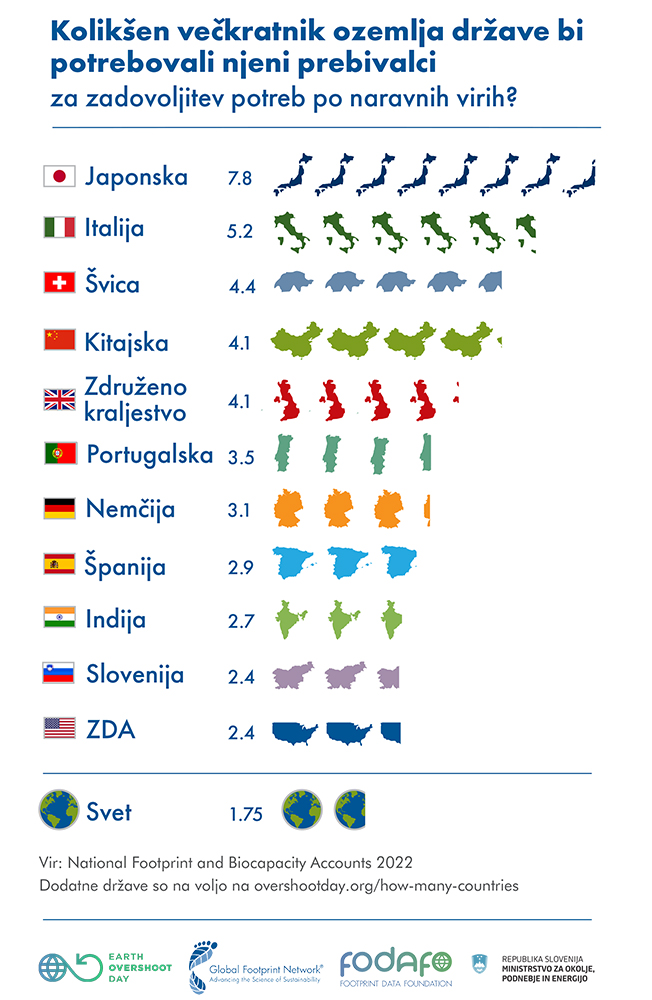
Since the early 1970s, humanity has been in an ecological deficit. While Switzerland’s biocapacity per person is 36% smaller than the world’s, its Ecological Footprint per inhabitant is about three times as large. The overload cannot continue forever. The effects of this global ecological overshoot can already be observed in the form of deforestation, soil erosion, loss of biodiversity and the accumulation of carbon dioxide in the atmosphere. Running an ecological deficit means that we are not only consuming the annual “interest” on our natural capital, but also depleting it by taking resources from the future to pay for the present. Operating on the ecological advances of future generations is obviously not a successful long-term strategy.
About Republic of Slovenia’s Ministry of Environment, Climate and Energy
The Slovenian Ministry of the Environment, Climate and Energy is addressing the present and future challenges in the fields of environment, energy and climate change. Its key priorities are efficient energy supply, introduction of modern energy policies, with an emphasis on increasing the share of renewable energy sources. These are key measures for protecting the environment, the country’s energy self-sufficiency and tackling climate change. The Ministry is also responsible for public passenger transport, sustainable mobility and transport policies, which will importantly contribute to Slovenia’s green transition.
About Global Footprint Network
Global Footprint Network is an international sustainability organisation dedicated to creating a world where all can thrive within the Earth’s means. This includes responding to climate change, biodiversity decline, and unmet human needs. Since 2003 we’ve engaged with more than 30 cities, 50 countries, and 70 global partners to improve their resource security by delivering scientific insights relevant for high-impact policy and investment decisions. www.footprintnetwork.org