



An analysis by Global Footprint Network and Greenings shows that no country’s national strategy meaningfully recognizes ecological overshoot, despite growing evidence that resource security now underpins economic stability.
Oakland CA, USA, July 27, 2026— A new analysis from Global Footprint Network and Greenings finds that national governments have not integrated overshoot impacts, including resource security, into their core economic strategies, leaving them exposed to risks that are already reshaping the global economy.
The report, Prepared for the Predictable? Overshoot and the Failure of Countries to Ready Themselves, released in support of Earth Overshoot Day, reviewed flagship national strategy documents from dozens of major economies, including five-year plans, budget speeches, and national security strategies.
Researchers, working with AI-assisted methods, evaluated how strongly each document recognizes ecological overshoot as an economic risk and whether that recognition translates into concrete policy and investment. The assessment used a five-dimension rubric, applied independently by four large language models, which produced consistent results.
Key findings:
The findings suggest that even when sustainability is acknowledged in public discourse, it is not consistently reflected in the structural decisions that shape national economies.
“Ecological overshoot is not a distant environmental concern; it’s a live economic risk,” said Dr. David Lin, co-author of the report. “Countries are so dependent on global resources that they are becoming increasingly vulnerable to resource shocks, as seen in supply disruptions triggered by events such as Russia’s invasion of Ukraine, the closure of the Strait of Hormuz, and the COVID-19 pandemic.”
The report recommends that governments establish cross-partisan task forces to identify and address gaps in their economic strategies. It also highlights emerging tools, such as the Transition Valuation Project, which applies an overshoot lens to infrastructure, corporate, and investment decisions.
The full analysis, including country-by-country scoring and methodology, is publicly available here https://footprintnetwork.org/prepared-for-the-predictable/
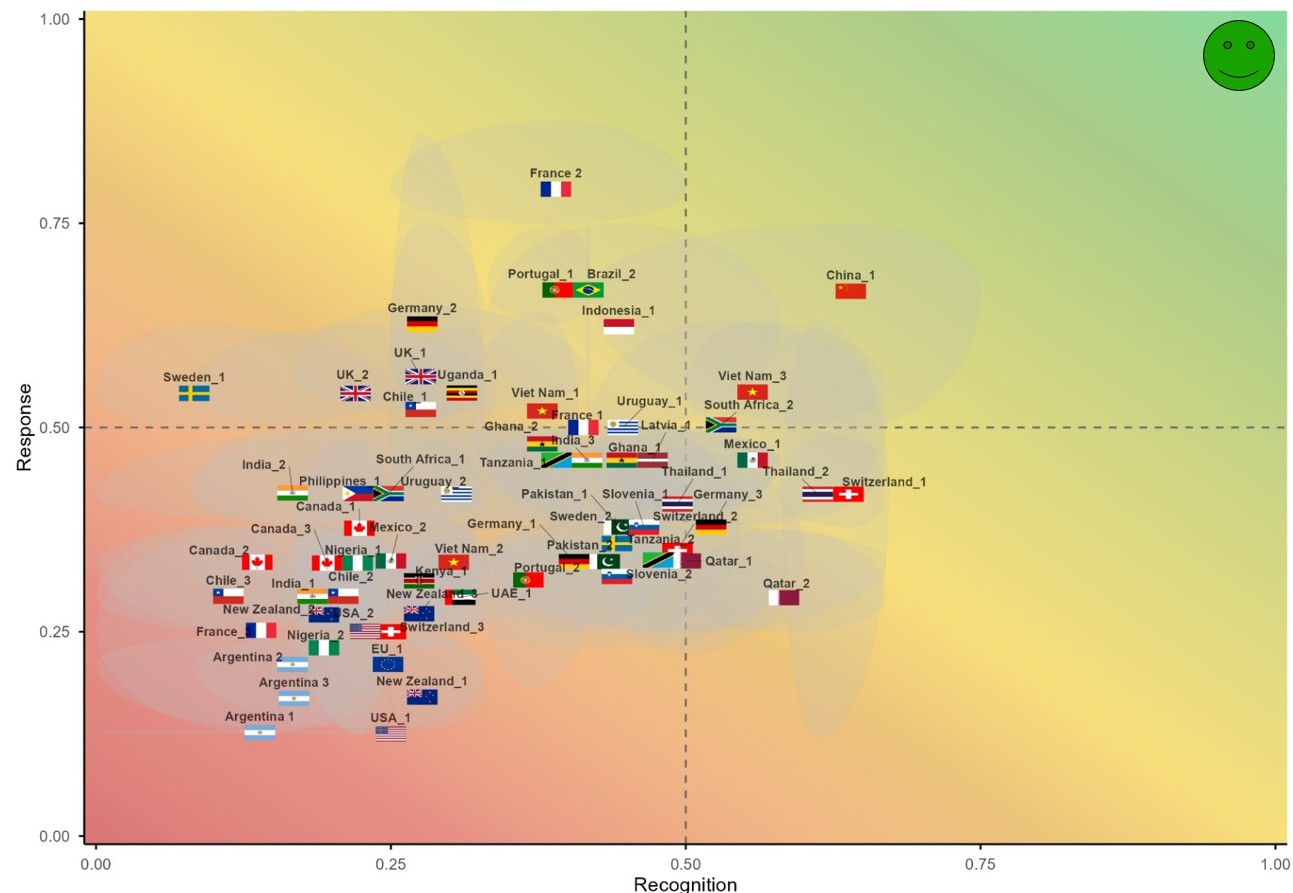
Figure 1: This shows the extent to which countries’ strategies recognize (x-axis) and respond to (y-axis) overshoot. The green smiley face in the upper right corner indicates where strategies need to be to meaningfully recognize and commensurately respond to overshoot.
Media contact: media@footprintnetwork.org
With sufficient anticipation, media interviews possible in English, French, Spanish, and German.
About Global Footprint Network: Promotes Earth Overshoot Day and applies Ecological Footprint and biocapacity accounting to enable countries, cities, and companies to meaningfully respond to overshoot.
About Greenings: Fosters champions who leverage the sustainability transition in ways that create value today.
###
♥ The full, downloadable report
♥ Technical Methodology which describes the process of the evaluation and documents the prompts used
♥ A summary for the general public
♥ A blog on the AI-based research methodology behind the report
♥ A blog on the report’s conclusions
♥ Access to a Gemini Notebook where you can query the LLM outputs for each country. This one is useful for finding out what the LLM evaluation generated. It is isolated from expectations or perspectives provided by further context. This helps to test and examine country assessments just the way the LLMs found on their own.
♥ Access to a Gemini Notebook where you can query all the information embedded in more context. Here, the LLM generated country assessments are enriched with the researchers’ previous publications and perspectives. This Notebook would be more useful for inquiries that have also an interpretation dimension, for instance, if you want to know more about the rationale behind the analysis.
♥ Earth Overshoot Day 2026 press release (on July 27th)
♥ How Earth Overshoot Day 2026 was calculated
♥ Ecological Footprint data for more than 150 countries and regions
♥ Infographics and videos available for media
♥ Solutions to reverse ecological overshoot and bolster biological regeneration
The Ecological Footprint is the most comprehensive biological resource accounting metric available. Based on 15,000 data points per country per year, it adds up all of people’s competing demands for biologically productive areas – food, timber, fibers, carbon sequestration, and accommodation of infrastructure. Currently, the carbon footprint, i.e., the carbon emissions from burning fossil fuel, make up 61 percent of humanity’s Ecological Footprint. The National Footprint and Biocapacity Accounts are now produced by FoDaFo with York University in Toronto.