


PRESS RELEASE
Earth Overshoot Day 2026 falls on July 30
Earth Overshoot Day 2026 falls on July 30
Earth Overshoot Day now falls nearly five months before year’s end, meaning a significant share of global economic activity depends on depleting our planet’s resources. This unsustainable pattern accelerates climate disruption and grows resource scarcity, creating serious risks for those unprepared for this future.
GENEVA, SWITZERLAND, June 5, 2026 – World Environment Day. Earth Overshoot Day 2026 lands on July 30, the date when humanity will have used up nature’s entire annual budget of ecological resources and services, according to Global Footprint Network, the international sustainability organization that pioneered the Ecological Footprint, and York University, which now produces the National Footprint and Biocapacity Accounts under the governance of FoDaFo.
Currently, humanity is using nature 73% faster than Earth’s ecosystems can regenerate, meaning this overshoot is equivalent to using 1.73 Earths. It is the highest level of global overshoot in human history. This level of overuse is possible because one can deplete natural capital. Such depletion compromises long-term resource security. The consequences are visible in deforestation, soil erosion, biodiversity loss, and the accumulation of CO₂ in the atmosphere, contributing to more frequent extreme weather events and declining food production.
The calculation
The calculation for Earth Overshoot Day is explained here. In essence, the date is determined using the latest edition of the National Footprint and Biocapacity Accounts (2026 edition). These accounts provide complete data through 2023 and estimates for 2024 and 2025 based on partial data and extrapolations. Global Footprint Network further estimated the likely results for 2026 based on preliminary and indicative data.
UN agencies and affiliated organizations supply the data used to calculate the Ecological Footprint and biocapacity. Because these datasets are regularly updated, past results are sometimes revised as well. This year, the most significant change was an upward revision of the ocean’s ability to absorb carbon. Together with a few smaller adjustments, this pushed Earth Overshoot Day eight days later than the 2025 estimate. Importantly, this shift reflects updated data, not actual reductions in overshoot.
At the same time, real-world trends moved in the opposite direction. Over the past year, the gap between humanity’s Ecological Footprint and the planet’s biocapacity grew wider, bringing Earth Overshoot Day two days earlier.
When combining these effects—eight days later due to data revisions and two days earlier due to real changes—the net result is that Earth Overshoot Day in 2026 falls six days later than in 2025, landing on July 30. Despite this apparent later date, 2026 still represents the highest level of ecological overshoot ever recorded.
The graph below shows the evolution of Earth Overshoot Days, recalculated with the latest data provided by the 2026 edition.
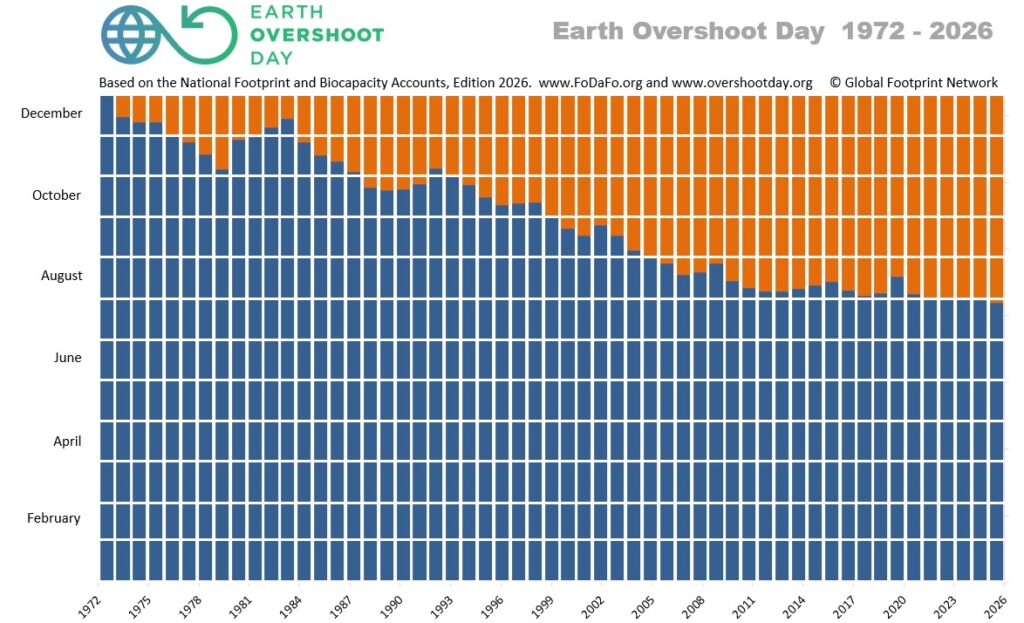
Figure 1: Earth Overshoot Days over the years. It shows global overshoot, starting in 1973, growing over time to cover over 5 months of the year in 2026. The red surface corresponds to the accumulated ecological debt due to global overshoot. It gets bigger every year by the additional overshoot. Visuals can be freely used as long as they are credited with “Global Footprint Network www.overshootday.org”. Choose file size to view/download:
English: small (0.2 MB jpg) | large (0.9 MB jpg)
Reading the trend
Earth Overshoot Day has remained relatively steady for the past decade, but it still falls early in the year, now after less than seven months have passed. For the remainder of the year, humanity lives by depleting natural capital, further eroding the biosphere. Even if the date stays unchanged, the pressure on the planet continues to grow, as the damage from overshoot accumulates over time.
Since global ecological overshoot began in the early 1970s, annual deficits have accumulated into a growing ecological debt. This debt now amounts to the equivalent of 20.6 years of the Earth’s full biological productivity. In other words, if ecological overshoot were fully reversible, it would take 20.6 years of the planet’s full regenerative capacity to restore the lost balance. Yet, it is unlikely that the entire ecological debt is reversible.
If overshoot continues at its current level, this debt will grow by approximately 0.73 planet-years each year. One measurable consequence of this cumulative overshoot is the rise in atmospheric CO₂ levels: since global overshoot began in 1972, greenhouse gas concentrations in the atmosphere have increased from 367 parts per million (ppm) CO₂ equivalent to 547 ppm in 2026, based on NOAA estimates.
“We are stretching the limits of how much ecological damage we can get away with – it is now a quarter into the 21st century and we owe the planet at least 20 years of ecological regeneration, even if we stop any further damage now. If we still want to call this planet home, this level of overshoot calls for a scale of ambition in adaptation and mitigation that should dwarf any previous historical investments we have made, for the sake of our common future,” comments Dr. Lewis Akenji, board member of Global Footprint Network.
Implications
Dr. Mathis Wackernagel, Global Footprint Network board member, states: “Because of the nature of physics, overshoot cannot last. It will end either by deliberate design or dumped-on disaster. It should not be too hard to choose which one is preferable, particularly in light of so many possible choices.”
This year, Earth Overshoot Day will focus on how countries are responding to ecological overshoot. Global Footprint Network, together with partner organizations, is preparing an assessment to evaluate the priority countries place on addressing overshoot and on preparing their economies for an inevitable future marked by climate disruption and resource scarcity.
Of course, many responses are available. Options to #MoveTheDate of Earth Overshoot Day in the right direction are already available, and many are financially advantageous. Opportunities exist in five key areas: Cities, Energy, Food, Population, and Planet. Power of Possibility highlights scalable solutions that move Earth Overshoot Day. For example, cutting CO2 emissions from fossil fuels by 50% would #MoveTheDate by three months. For more examples, check the website.
Some businesses already #MoveTheDate in the right direction as they grow. These businesses are well positioned to gain value in the predictable future of increasing climate change and resource constraints, because they will be needed more and will themselves not run into ecological constraints. Any business calling itself “regenerative” or “circular” would need to be able to demonstrate that they do reduce global overshoot, otherwise their label would be deceiving.
“Ending overshoot is essential. It is also possible, given human creativity,” comments Dr. Jane Muncke, board member of Global Footprint Network.
Additional resources
How Earth Overshoot Day 2026 was calculated
How to compare the date of Earth Overshoot Day to previous years
Ecological Footprint data for more than 150 countries and regions
What exactly is the problem?
Infographics and videos available for media
Introduction to the implications of overshoot
Solutions to reverse ecological overshoot and bolster biological regeneration
About the Ecological Footprint
The Ecological Footprint is the most comprehensive biological resource accounting metric available. Based on 15,000 data points per country per year, it adds up all of people’s competing demands for biologically productive areas – food, timber, fibers, carbon sequestration, and accommodation of infrastructure. Currently, the carbon footprint, i.e., the carbon emissions from burning fossil fuel, make up 61 percent of humanity’s Ecological Footprint. The National Footprint and Biocapacity Accounts are now produced by FoDaFo with York University in Toronto.
About Global Footprint Network
Global Footprint Network is an international sustainability organization that is helping the world live within the Earth’s means and respond to climate change. Since 2003 we’ve engaged with more than 50 countries, 30 cities, and 70 global partners to deliver scientific insights that have driven high-impact policy and investment decisions. Together, we’re creating a future where all of us can thrive within the limits of our one planet. www.footprintnetwork.org
Media Contact
With anticipation, media interviews possible in English, French, Spanish, and German.