


An analysis by Global Footprint Network and Greenings shows that no country’s national strategy meaningfully recognizes ecological overshoot, despite growing evidence that resource security now underpins economic stability.
GENEVA, SWITZERLAND, July 30, 2026. This year’s Earth Overshoot Day falls on July 30, the date when humanity’s demand on nature exceeds what Earth’s ecosystems can regenerate in that year, according to Global Footprint Network. Humanity is currently using nature 73% faster than ecosystems can regenerate, the equivalent of living off 1.73 Earths.
This year’s later date is the result of revised data rather than any easing of resource use. An upward revision of the ocean’s capacity to absorb carbon, along with smaller adjustments, moved the date eight days later. Real growth in overshoot over the past year moved it two days earlier. The net result is six days later than in 2025. On a consistent data set, this year’s overshoot is the largest ever recorded.
A variety of factors contribute to overshoot, such as cars, power plants and factories emitting more CO₂ than the biosphere can absorb, more freshwater being consumed than is replenished, more trees being harvested than can regrow, and more fish being caught than stocks can replenish. Overuse depletes natural capital and threatens long-term economic security worldwide.
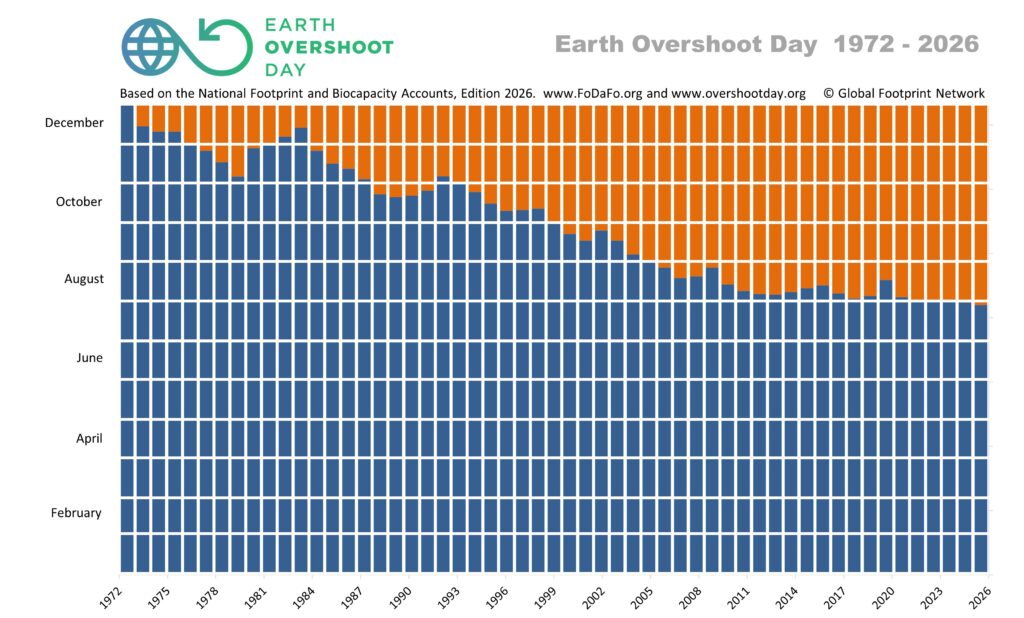
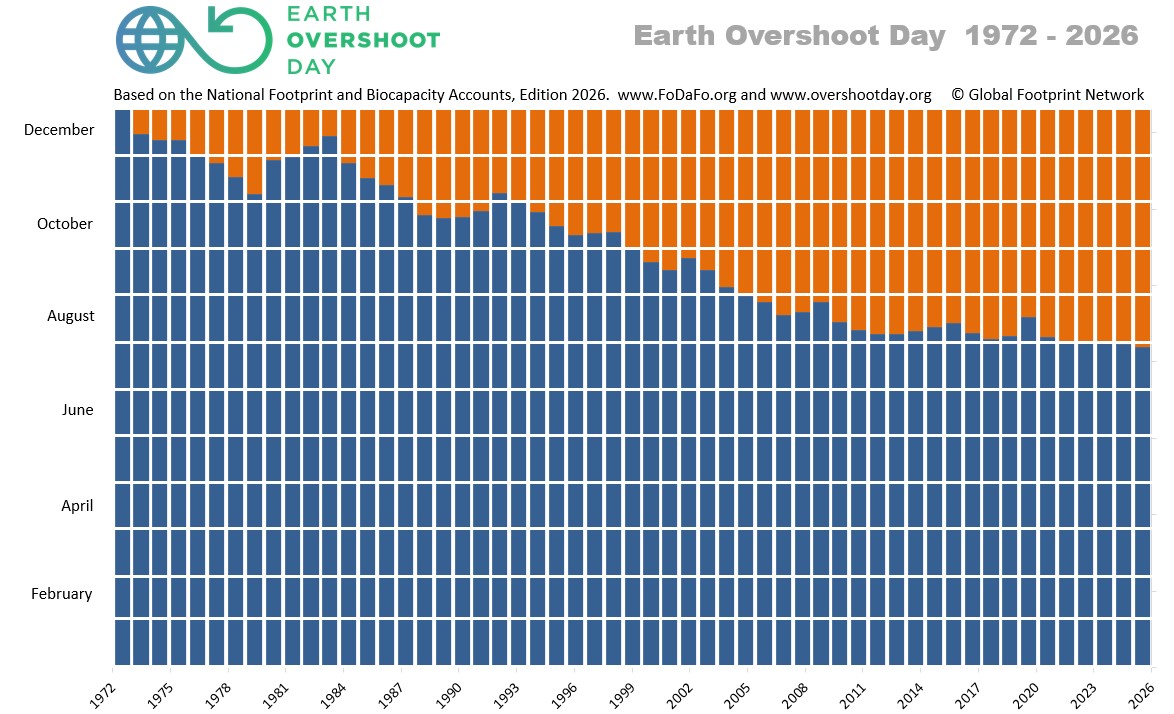
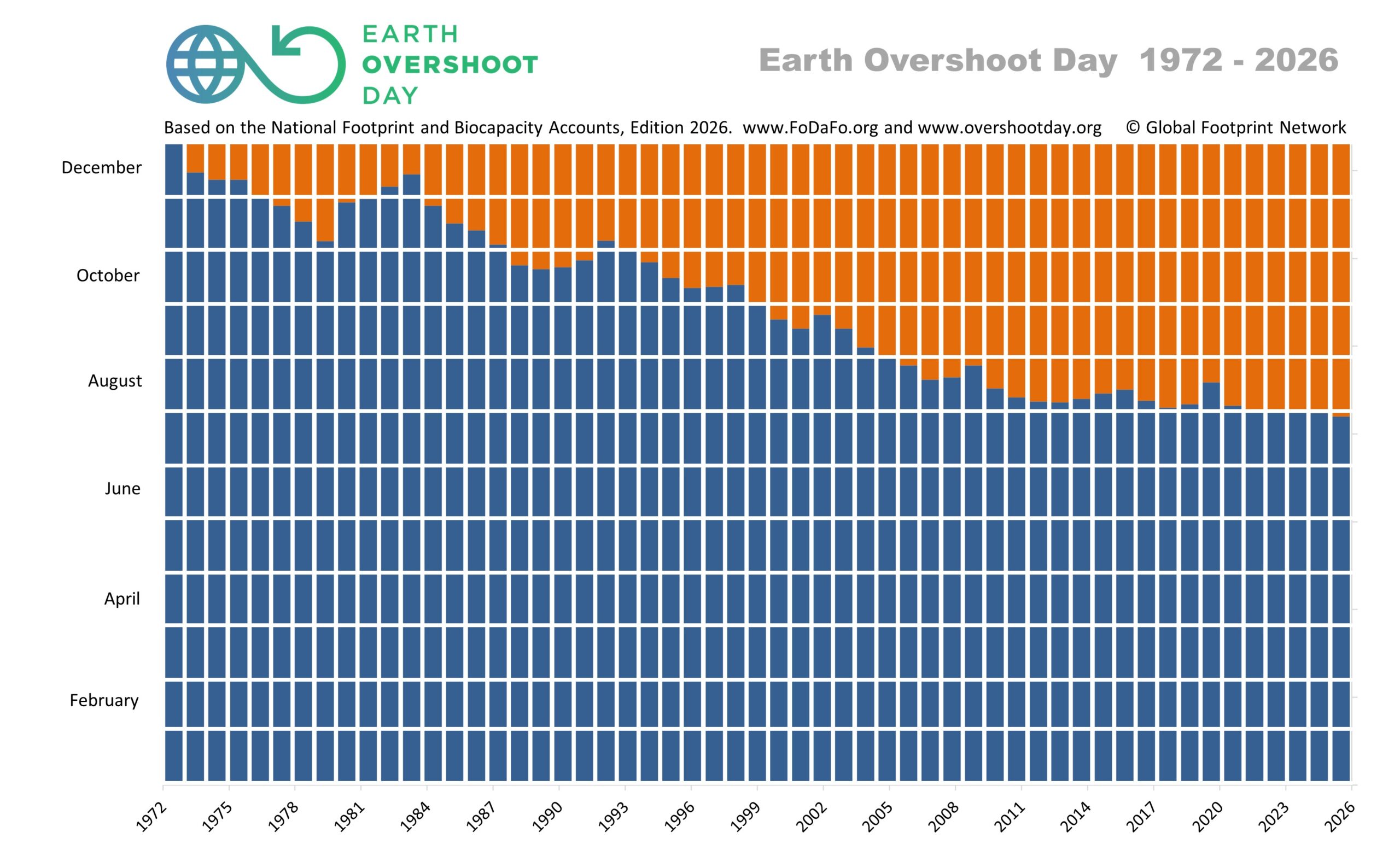
Figure 1: This shows how the dates of Earth Overshoot Day have shifted over time, according to the newest edition of the National Footprint and Biocapacity Accounts. Choose file size to view/download: small (0.2 MB jpg) | large (0.9 MB jpg)
Although this year’s overshoot is the largest ever, the date has remained within a narrow window for over 15 years. The orange section of the graph shows the portion of the year humanity lives by further depleting our planet. Damage from overshoot is cumulative, which means that even as the date holds steady, the pressure on the planet intensifies. Every year’s overshoot adds to the already existing ecological debt. (figure credit: Global Footprint Network www.overshootday.org)
Despite this overshoot, hardly any national governments treat resource security as a central part of their economic planning, even as ecological overshoot fuels stagflation, food and energy insecurity, health crises, and conflict, according to the special report “Prepared for the Predictable? Overshoot and the Failure of Countries to Ready Themselves” which Global Footprint Network and Greenings produced for Earth Overshoot Day.
This analysis applied an evaluation framework across four leading large language models, with outputs verified against published policy documents. With this research, Global Footprint Network and Greenings identified which countries recognize overshoot as an economic threat and how far their policies actually go to prepare for it. They found that most countries treat sustainability as a side issue rather than a structural risk to growth, fiscal stability, and long-term competitiveness, and no country fully connects economic planning to physical resource limits.
The findings suggest that even when sustainability is acknowledged in public discourse, it is not consistently reflected in the structural decisions that shape national economies.
More specifically:
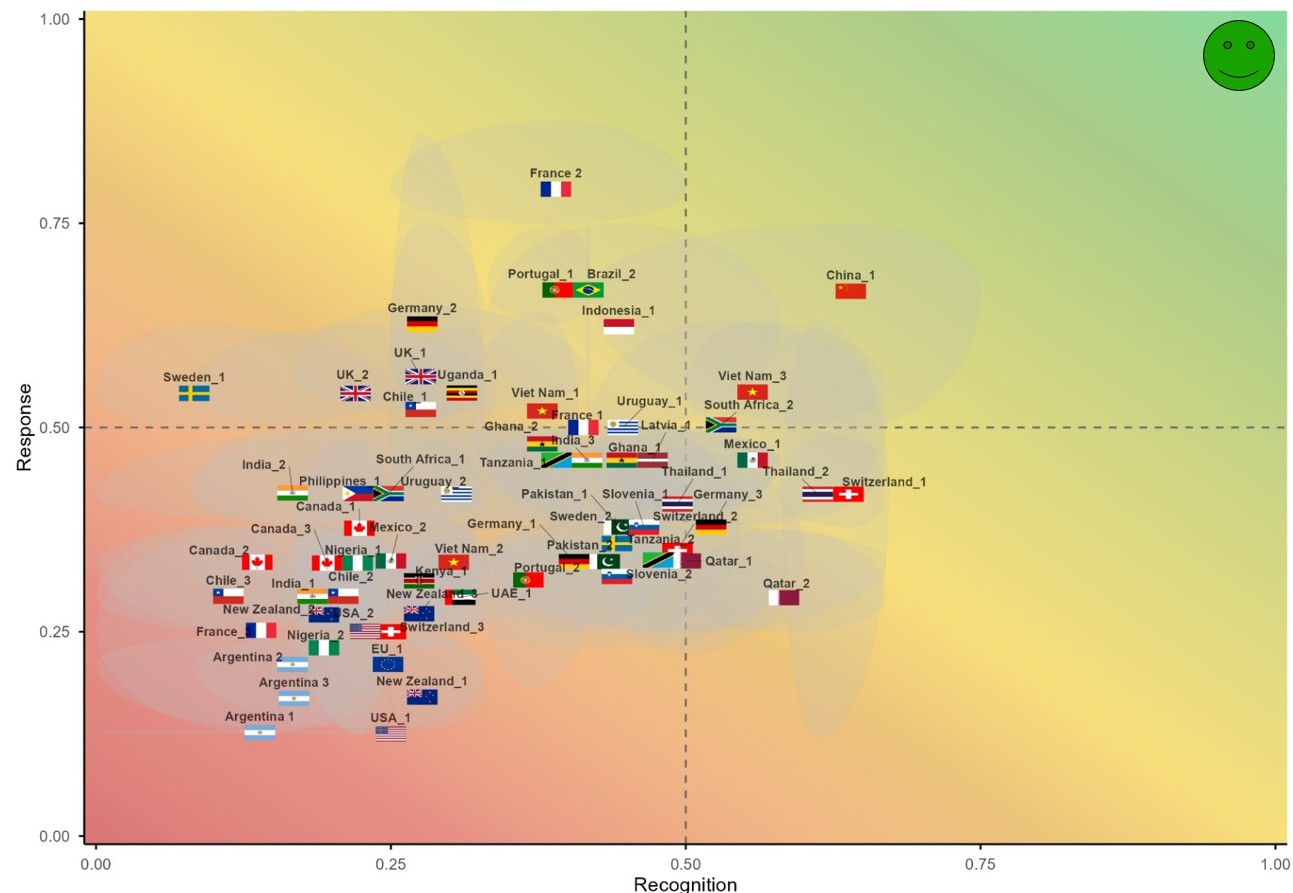
Figure 2: This shows the extent to which countries’ strategies recognize (x-axis) and respond to (y-axis) overshoot. The green smiley face in the upper right corner indicates where strategies need to be, according to our rubric, to meaningfully recognize and commensurately respond to overshoot. The grey ellipsoid clouds represent the range of scores produced for each analyzed strategy document. Download plot: jpg (0.12 MB) | pdf (0.15 MB, vector)
The report’s figure included above shows the extent to which countries’ strategy documents recognize (x-axis) and respond to (y-axis) overshoot. The green smiley face in the upper right corner indicates where strategies need to be, according to our rubric, to meaningfully recognize and respond to overshoot. The grey ellipsoid clouds represent the range of scores produced for each analyzed strategy document.
“Overshoot is not a distant environmental concern. It is already producing economic impacts,” says Dr. David Lin, one of the lead authors of the study and Chief Scientist at Global Footprint Network. “Countries that plan for a resource-constrained future will be the ones best positioned to withstand it. Right now, almost none are.”
Since the early 1970s, humanity’s demand has consistently outstripped biocapacity, the planet’s ability to regenerate the resources and critical ecological services that sustain our economies. The report’s authors recommend every country establish a task force or a parliamentary commission to map their resource dependencies, financial exposure, and options for building resilience before the next resource shock hits.
“Resource security has profound implications for a nation’s health, economic resilience and security. What surprised me most is that governments are still largely focused on treating symptoms instead of diagnosing and responding to the underlying condition of ecological overshoot,” commented Dr. Kristin Kostka, board member of Greenings.
“Resource security shapes transition pathways. Who’s flying blind, and who’s correcting course?” added Dennis West, founding chair of Greenings.
The full report, including detailed country findings and methodology, is available at https://footprintnetwork.org/prepared-for-the-predictable
There are many ways to respond to overshoot. If effective, overshoot will end by design, rather than by disaster. The Power of Possibility highlights 100+ options that are already available and financially advantageous in five key areas: Cities, Energy, Food, Population, and Planet. For example, a 50% reduction in CO₂ emissions from fossil fuel burning would #MoveTheDate by three months. There are also businesses that #MoveTheDate as they expand. Such businesses are best positioned to gain value in a future of climate change and resource constraints. Regions, cities, companies, and countries that have not prepared for this predictable reality face significantly higher risks.
###
Media contact: media@footprintnetwork.org
With sufficient anticipation, media interviews possible in English, French, Spanish, and German.
♥ Press release in German, Spanish, Dutch, French
♥ Prepared for the Predictable? Report for Earth Overshoot Day, with tools and background materials, including Technical Methodology. a summary for the general public and much more
♥ How Earth Overshoot Day 2026 was calculated
♥ Country Overshoot Days
♥ Ecological Footprint data for more than 150 countries and regions
♥ Infographics and videos available for media
♥ Solutions to reverse ecological overshoot and bolster biological regeneration
Global Footprint Network is an international research organization that develops and applies the concepts of ecological footprint and biocapacity, helping governments, businesses, and individuals meaningfully respond to global resource depletion driven by ecological overshoot. It also coordinates Earth Overshoot Day, marking the date each year when humanity’s demand on nature exceeds what Earth can regenerate. www.footprintnetwork.org
Greenings is an independent, not-for-profit member association, based in Switzerland, founded in 2010, connecting leaders in transition from across business, government, academia, civil society and finance. Our mission is to make champions by providing the platform for leveraging the transition to create value now. www.greenings.org
The Ecological Footprint is the most comprehensive biological resource accounting metric available. Based on 15,000 data points per country per year, it adds up all of people’s competing demands for biologically productive areas – food, timber, fibers, carbon sequestration, and accommodation of infrastructure. Currently, the carbon footprint, i.e., the carbon emissions from burning fossil fuel, make up 61 percent of humanity’s Ecological Footprint. The National Footprint and Biocapacity Accounts are now produced by FoDaFo with York University in Toronto.