

PERSPECTIEF OP EARTH OVERSHOOT DAY
Nederland leeft op krediet. Onderzoek toont aan dat de overheid zich onvoldoende voorbereidt op de voorspelbare toekomst.
van Joost Brinkman, Directeur Nederland, Global Footprint Network
ENGLISH VERSION BELOW
Utrecht, 30 juli 2026 – Vandaag is het Earth Overshoot Day: in 7 maanden heeft de mensheid al evenveel van de aarde gevraagd als onze planeet in een heel jaar kan vernieuwen. Nederland vraagt structureel meer van de natuur dan het eigen grondgebied kan leveren – voor voedsel, wonen en het opvangen van CO2 – en dekt dat tekort af met import en het vertrouwen dat de rest van de wereld zijn fossiele emissies absorbeert. Op een eindige planeet is dit echter niet houdbaar en de risico’s hiervan zijn voorspelbaar. Overheden die hun land en inwoners willen beschermen, bereiden zich voor op een wereld van grondstoffenschaarste en klimaatverandering – niet pas wanneer de crisis toeslaat.
Nieuw wereldwijd onderzoek van Global Footprint Network en Greenings laat zien dat economische strategieën van landen grotendeels blind zijn voor de risico’s van Overshoot. Voor het rapport “Prepared for the Predictable?” analyseerden David Lin, Mathis Wackernagel en collega’s de officiële strategiedocumenten van tientallen landen. Conclusie: geen enkel land behandelt grondstoffenschaarste en Overshoot als een serieus risico voor de eigen economie – ook de Europese Unie niet, die lager scoort dan haar eigen duurzaamheidsrapportage zou doen vermoeden.
Die titel is veelzeggend. Klimaatverstoring en grondstoffentekorten zijn geen verrassing die ons overkomt; wetenschappers voorspellen ze al ruim een halve eeuw. De kerntaak van een overheid is haar burgers tegen risico’s te beschermen. Wanneer een risico voorspelbaar is en het beleid er onvoldoende op inspeelt, is dat geen pech of overmacht, maar een overheid die faalt in haar meest basale taak.
Dat falen is geen toeval. Sinds de jaren tachtig bouwden we in Nederland en daarbuiten, onze welvaart vooral op met gedereguleerde marktwerking, fossiele brandstoffen en het uitbesteden van productie van goederen aan lagelonenlanden. Wie ons voedsel, onze energie, onze medicijnen en onze grondstoffen daadwerkelijk levert – en wat er gebeurt als die levering wegvalt – kreeg nauwelijks aandacht. Het resultaat: Europa en Nederland in het bijzonder zijn extreem afhankelijk geworden van de rest van de wereld, terwijl het ver boven zijn eigen ecologische middelen leeft.
Dat model staat nu van meerdere kanten tegelijk onder druk: de Russische invasie van Oekraïne liet zien hoe snel een energie- en voedselcrisis toeslaat wanneer een belangrijke leverancier wegvalt; langdurige bondgenoten blijken minder betrouwbaar dan aangenomen; de sluiting van de Straat van Hormuz legde in één nacht 20 procent van de wereldwijde olietransport plat; en klimaatontwrichting veroorzaakt steeds grotere schokken voor oogsten, watervoorziening en verzekerbaarheid. Vier crises, één boodschap: het fundament van onze economie is niet op orde.
Terwijl dit rapport oproept tot meer weerbaarheid, beweegt het Europese beleid de andere kant op. Begin 2026 zwakte de Omnibus-vereenvoudiging duurzaamheidsrapportage en ketenverantwoordelijkheid af. Op 17 juli versoepelde de Europese Commissie het emissiehandelssysteem, waardoor de industrie tot 2038 gratis emissierechten behoudt. Onder druk van de fossiele industrie, de regering-Trump en zeventien lidstaten ligt er een voorstel om de Europese Methaanregulering met drie jaar uit te stellen. Precies wanneer voorspelbare risico’s om weerbaarheid vragen, kiest Europa er keer op keer voor om maatregelen die echt nodig zijn uit te stellen.
Je kunt deze crises los van elkaar bekijken, maar ze wijzen allemaal naar hetzelfde: vijftig jaar lang hebben we het fundament van onze economie verwaarloosd en de rekening voor ons uitgeschoven. Dat beseffen is enorm waardevol: het helpt ons risico’s én kansen scherper te zien. Juist omdat al deze crises nu samenkomen, ontstaat er momentum om over politieke, sectorale en institutionele scheidslijnen heen samen te werken aan een economie die op eigen benen kan staan – niet uit nostalgie, maar omdat het de enige manier is om onze welvaart en veiligheid te beschermen.
Het onderzoek beveelt landen aan om een task force in te stellen die partijgrenzen overstijgt, om grondstofafhankelijkheden en financiële blootstelling in kaart te brengen. Voor Nederland, met zijn open economie en beperkte binnenlandse biocapaciteit, is dat geen vrijblijvend advies. Het fundament van onze economie op orde krijgen is het werk van een generatie – maar het moment om daar eindelijk samen mee te beginnen was zelden zo duidelijk.
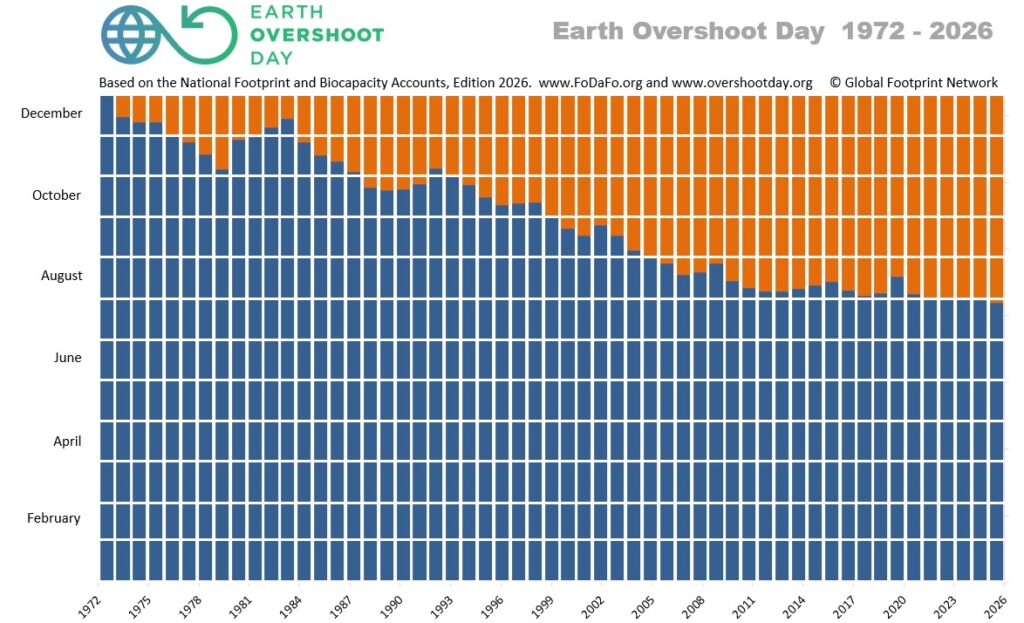
Figuur 1: Earth Overshoot Days door de jaren heen. Deze figuur toont de mondiale overshoot, die begint in 1973 en in de loop der tijd toeneemt tot meer dan vijf maanden van het jaar in 2026. Het rode oppervlak komt overeen met de geaccumuleerde ecologische schuld als gevolg van de mondiale overshoot. Dit wordt elk jaar groter door de bijkomende overshoot. Visuals mogen vrij worden gebruikt, mits ze worden gecrediteerd met “Global Footprint Network www.overshootday.org”. Kies bestandsgrootte om te bekijken/downloaden: English: small (0.2 MB jpg) | large (0.9 MB jpg)
Over het onderzoek
Dit persbericht is gebaseerd op ‘Prepared for the Predictable? Overshoot and the Failure of Countries to Ready Themselves’ een rapport van het Global Footprint Network en Greenings door David Lin, Ph.D., Mathis Wackernagel, Ph.D. en collega’s. Mede-auteur Dr. David Lin: ‘Ecological overshoot is not a distant environmental concern; it’s a live economic risk.’ Het Global Footprint Network berekent jaarlijks Earth Overshoot Day op basis van de National Footprint and Biocapacity Accounts. Meer informatie: https://footprintnetwork.org/prepared-for-the-predictable
mediacontact:
Joost Brinkman
E: joost@sinkit.org
T: +31 6 12 60 30 53
PRESS RELEASE
The Netherlands is living on credit. Research shows the government is not adequately preparing for a predictable future.
Utrecht, the Netherlands, 30 July 2026 – Today is Earth Overshoot Day: in 7 months, humanity has already demanded as much from the Earth as our planet can renew in an entire year. The Netherlands demands more from nature than its own territory can supply – for food, housing and absorbing CO2 – and covers that gap through imports and by relying on the rest of the world to absorb its fossil emissions. On a finite planet, however, this is risky, and the risks involved are predictable. Governments that want to protect their countries’ best interest would prepare for a world of resource shortages and climate change.
New global research from the Global Footprint Network and Greenings shows that countries’ economic strategies are largely blind to the risks of overshoot. For the report “Prepared for the Predictable?”, David Lin, Mathis Wackernagel and colleagues analysed the official strategy documents of dozens of countries. Their conclusion: not a single country treats resource scarcity and Overshoot as a serious risk to its own economy – not even the European Union, which scores lower than its own sustainability reporting would suggest.
That title is telling. Climate disruption and resource shortages are not some surprise that has befallen us; scientists have been predicting them for well over half a century. A government’s core task is to protect its citizens from risk. When a risk is predictable and policy fails to adequately address it, that is not bad luck or force majeure, but a government failing at its most basic job.
That failure is no coincidence. Since the 1980s, successive governments, in the Netherlands and beyond, have built prosperity primarily on extractive strategies, deregulated market forces, and the international division of labour. Who actually supplies our food, our energy, our medicines and our raw materials – and what happens if that supply disappears – received barely any attention. The result: the Netherlands has become extremely resource dependent on the rest of the world, while living far beyond its own ecological means.
That model is now under pressure. Symptoms of this overstretched situation abound: Russia’s invasion of Ukraine showed how quickly an energy and food crisis can hit when a major supplier disappears; long-time allies have proven less reliable than assumed; the closure of the Strait of Hormuz shut down 20 percent of global oil shipping overnight; and climate disruption is causing ever-larger shocks to harvests, water supply and insurability. Four crises, one message: the foundations of our economy are not in order.
While this report calls for greater resilience, European policy is moving the other way. In early 2026, the Omnibus simplification package significantly weakened corporate sustainability reporting and supply-chain due-diligence obligations. On 17 July, the European Commission eased the Emissions Trading System, letting industry keep free emission allowances until 2038. Under pressure from the fossil fuel industry, the Trump administration and seventeen member states, there is now also a proposal to postpone the EU Methane Regulation by three years. Precisely when predictable risks call for more resilience and actions, Europe keeps choosing to delay it.
You can look at these crises separately, but they all point to the same driver: for fifty years we have neglected the foundations of our economy and pushed the bill down the road. Realizing that is enormously valuable: it helps us see both risks and opportunities more clearly. Precisely because all these crises are converging now, there is momentum to work together across political, sectoral and institutional divides on an economy that can stand on its own feet – not out of nostalgia, but because it is the only way to protect our prosperity and security.
The research recommends that countries set up a cross-party task force to map resource dependencies and financial exposure. For the Netherlands, with its open economy and limited domestic biocapacity, that is not a non-committal piece of advice. Getting the foundations of our economy in order is the work of a generation – but the moment to finally start doing it together has rarely been so clear.
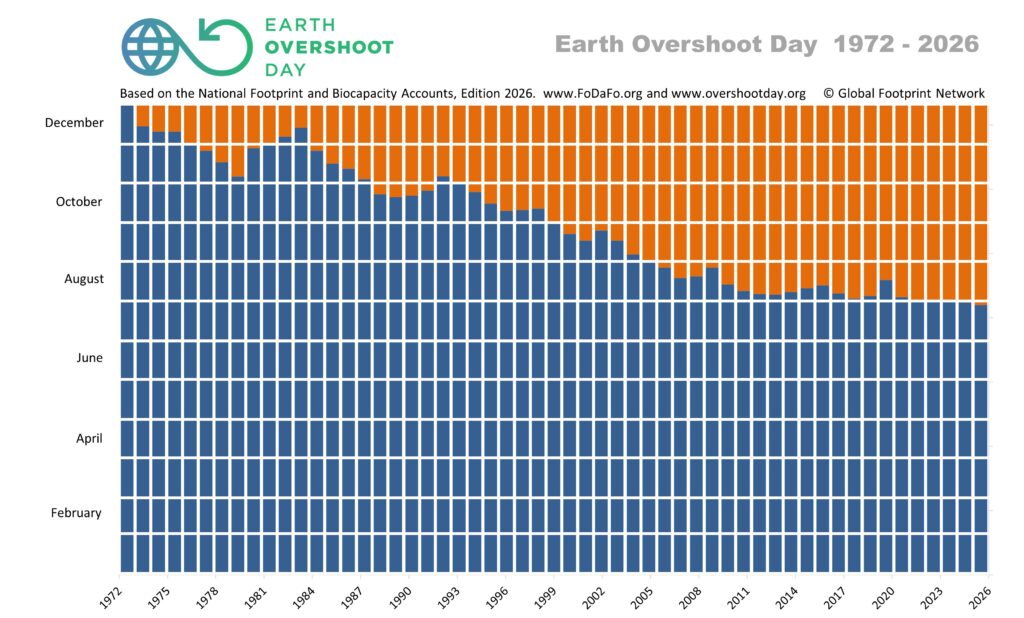
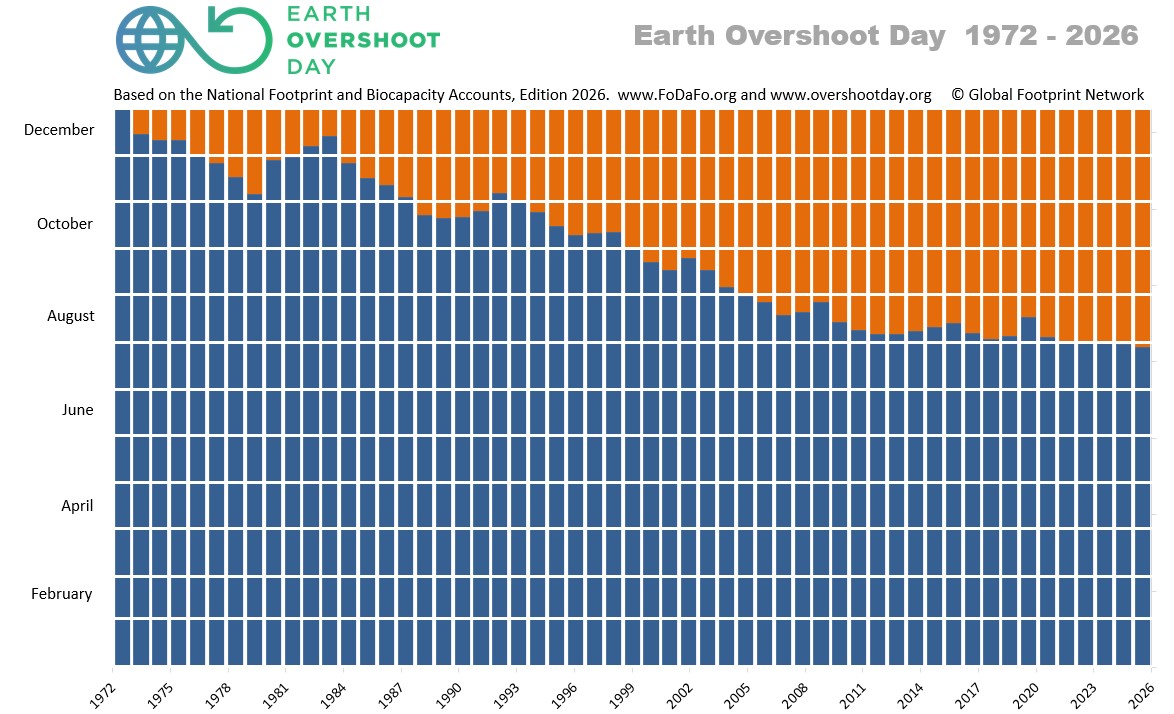
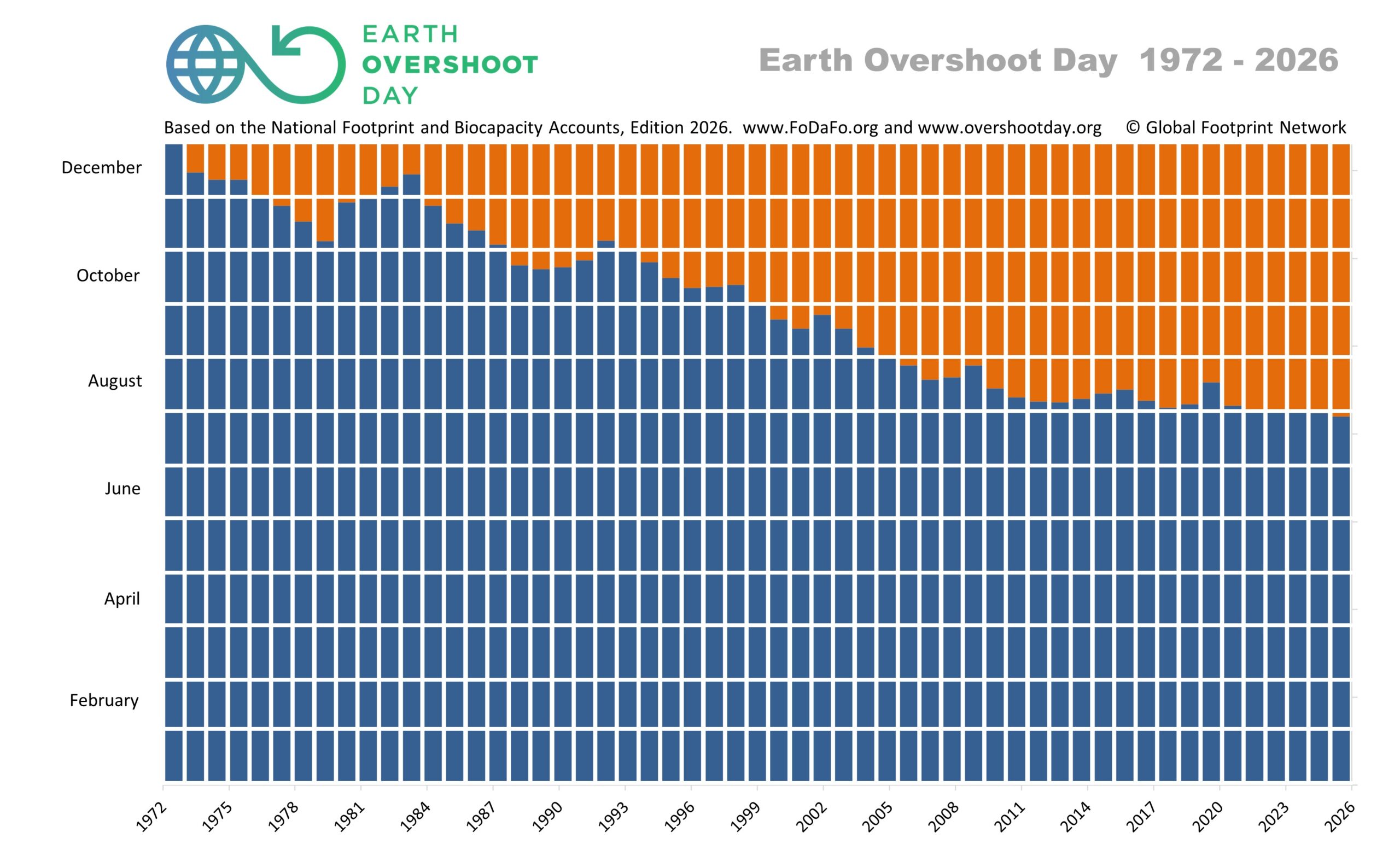
Figure 1: Earth Overshoot Days over the years. It shows global overshoot, starting in 1973, growing over time to cover over 5 months of the year in 2026. The red surface corresponds to the accumulated ecological debt due to global overshoot. It gets bigger every year by the additional overshoot. Visuals can be freely used as long as they are credited with “Global Footprint Network www.overshootday.org”. Choose file size to view/download:
English: small (0.2 MB jpg) | large (0.9 MB jpg)
About the research
This press release is based on ‘Prepared for the Predictable? Overshoot and the Failure of Countries to Ready Themselves’ (July 2026), a report by the Global Footprint Network and Greenings by David Lin, Ph.D., Mathis Wackernagel, Ph.D. and colleagues. Co-author Dr. David Lin: “Ecological overshoot is not a distant environmental concern; it’s a live economic risk.” The Global Footprint Network calculates Earth Overshoot Day every year based on the National Footprint and Biocapacity Accounts. More information: https://footprintnetwork.org/prepared-for-the-predictable
Media contact:
Joost Brinkman
E: joost@sinkit.org
T: +31 6 12 60 30 53
Additional resources
How Earth Overshoot Day 2026 was calculated
How to compare the date of Earth Overshoot Day to previous years
Ecological Footprint data for more than 150 countries and regions
What exactly is the problem?
Infographics and videos available for media
Introduction to the implications of overshoot
Solutions to reverse ecological overshoot and bolster biological regeneration
About the Ecological Footprint
The Ecological Footprint is the most comprehensive biological resource accounting metric available. Based on 15,000 data points per country per year, it adds up all of people’s competing demands for biologically productive areas – food, timber, fibers, carbon sequestration, and accommodation of infrastructure. Currently, the carbon footprint, i.e., the carbon emissions from burning fossil fuel, make up 61 percent of humanity’s Ecological Footprint. The National Footprint and Biocapacity Accounts are now produced by FoDaFo with York University in Toronto.
About Global Footprint Network
Global Footprint Network is an international sustainability organization that is helping the world live within the Earth’s means and respond to climate change. Since 2003 we’ve engaged with more than 50 countries, 30 cities, and 70 global partners to deliver scientific insights that have driven high-impact policy and investment decisions. Together, we’re creating a future where all of us can thrive within the limits of our one planet. www.footprintnetwork.org
Media Contact
With anticipation, media interviews possible in English, French, Spanish, and German.